

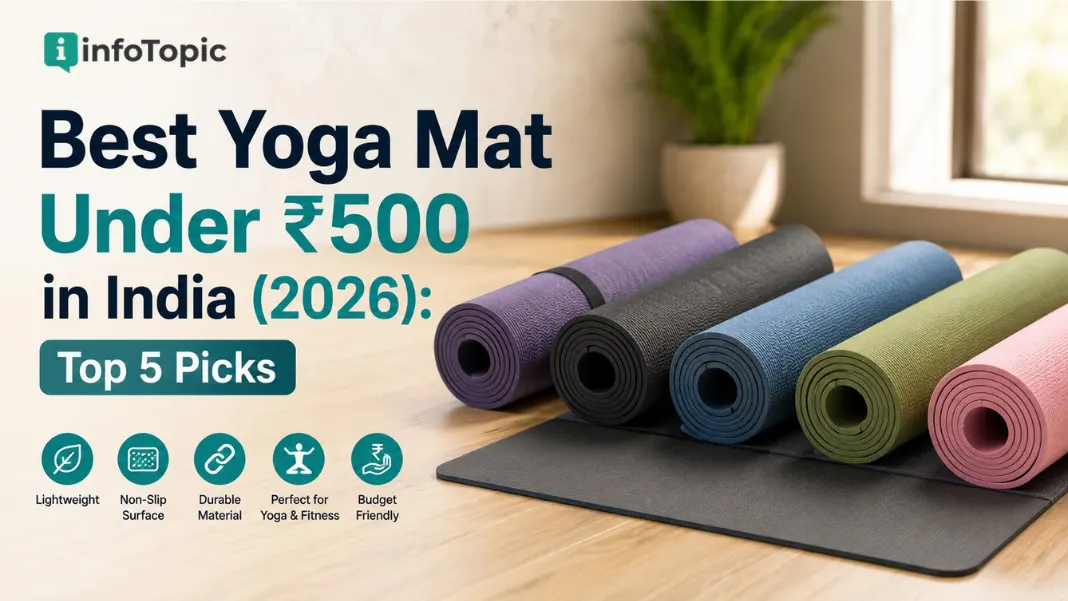
My first yoga mat cost ₹299. It smelled like a tyre shop for two weeks and slid across my bedroom tile every time I moved into downward dog. That’s the honest starting point for most people shopping for the best yoga mat under 500 in India, and it’s exactly why this guide exists. You don’t need to spend a fortune to start a home practice. You do need to know what separates a decent budget mat from a slippery, paper-thin waste of money.
This isn’t a theoretical roundup. Infotopic has spent years testing budget fitness gear for Indian homes, from wireless earbuds to fitness trackers, and mats are no different. The rules for picking the best yoga mat under 500 in India are simple once you know them: thickness, material, and grip texture decide almost everything else.
The Short Version
If you want the fastest answer: the best yoga mat under 500 in India is a 4-6mm PVC or EVA mat with a textured, double-sided grip and a size of at least 183 x 61 cm. Boldfit, Cockatoo, and Lifelong all sell reliable yoga mats under ₹500 on Amazon and Flipkart. Air a new mat out for a day before your first session, and check the return window before you buy.
Why Beginners Struggle With Yoga Mats More Than They Should
Here’s the problem nobody tells you about before your first class at home. You watch a YouTube tutorial, roll out whatever mat you grabbed, and thirty seconds into your first sun salutation your hands are sliding forward on a smooth vinyl surface. That’s not a “you” problem. That’s a mat problem. And it’s the single biggest reason people quit home yoga in the first two weeks.
Indian floors make this worse. Marble, polished tile, granite – these are the default flooring types across most homes here, and they’re exactly the surfaces a bad mat performs worst on. A good yoga mat under 500 rupees needs to work with that reality, not against it. That’s really the whole search behind “best yoga mat under 500 in India” – people aren’t looking for a luxury item, they’re looking for something that just stays put.
Why a Good Yoga Mat Matters for Beginners
A mat isn’t just padding. It’s the one piece of equipment standing between your joints and a hard floor, and between a confident pose and an ankle that slides out from under you mid-warrior. Mayo Clinic’s overview of yoga notes that regular practice can improve flexibility, balance, and stress levels over time – but none of that happens if you’re too busy fighting your mat to focus on your breathing.
For beginners specifically, three things matter more than brand name: enough cushioning to protect knees and wrists, a grip surface that holds even when you sweat, and a size that actually fits your height. Skip any one of those and the mat becomes the obstacle instead of the tool.
Benefits of Practicing Yoga at Home
Home practice removes the two biggest barriers people cite for not doing yoga at all: cost and time. No studio membership, no commute, no fixed class schedule. You roll out a mat in your living room at 6am or 9pm, whichever works. The World Health Organization recommends adults get at least 150 minutes of moderate activity a week, and a 20-minute home yoga session, done consistently, chips away at that target without needing a gym.
There’s a quieter benefit too. A dedicated yoga mat under ₹500 creates a physical cue. Roll it out, and your brain switches into practice mode. Skip the mat and just stretch on the floor, and most people find they quit halfway through. The object matters more than people expect.
Things to Check Before Buying a Budget Yoga Mat
This is where most first-time buyers of a budget yoga mat under 500 get it wrong. They compare prices and colours and skip the three specs that actually determine whether the mat survives past week three.
Mat Thickness and Cushioning
Every yoga mat under 500 rupees in India tends to land around 4mm thick. That’s genuinely fine for most beginner practice – Hatha, gentle Vinyasa, stretching, meditation. It struggles the moment you add serious floor work like Ashtanga transitions or knee-heavy poses on a hard tile floor, where you’ll feel every millimetre missing. If your knees are sensitive, or your floor is marble, budget an extra ₹200-300 for a 6mm option instead of forcing a 4mm mat to do a job it wasn’t built for.
Material: PVC vs TPE vs Rubber
This is the real fork in the road for anyone comparing yoga mat pvc vs tpe options at this price point. PVC is what most sub-₹500 mats are made of – it’s cheap, durable, and holds its shape for years, but it has almost no give and can smell strongly for the first few days. TPE mats are lighter, closed-cell (so sweat doesn’t soak in), and largely odour-free, but you’ll rarely find a genuine TPE mat under ₹500; most in that range are TPE-blend or plain EVA foam, which is softer but wears out faster. Natural rubber is the best grip of the three and is basically absent from this price bracket entirely.
My honest take: for a yoga mat under ₹500, PVC beats EVA foam nine times out of ten. EVA feels nicer on day one and starts pilling and losing shape by month two.
Grip and Non-Slip Surface
On a yoga mat under ₹500, a non-slip surface matters more than thickness once you start sweating. Look for a textured top layer, not a smooth glossy one – run your hand across it in the product photos or, better, read the review section for words like “sticky” or “held even when sweaty.” A wavy or ridged underside also helps on tile, stopping the whole mat from creeping forward during a flow sequence.
Size and Portability
Standard mats in the yoga mat under 500 category run 183 x 61 cm (6 feet by 2 feet), which fits most adults comfortably. If you’re above 5’10”, check the listing specifically – a handful of budget brands trim a few centimetres to cut costs. Weight sits around 500-700 grams for mats in this bracket, light enough to roll and carry without a dedicated bag, though a couple of listings throw one in for free.
Best Yoga Mats Under ₹500 in India (2026)
Here are five picks for the best yoga mat under 500 in India right now, based on what’s consistently available and well-reviewed on Amazon India and Flipkart. Prices shift with sales, so treat these as a starting bracket rather than a fixed number.
1. Boldfit EVA Yoga Mat (4mm) – The most widely stocked yoga mat under ₹500 in India, and for good reason. Double-sided anti-slip texture, comes with a carry strap, and Boldfit’s customer support genuinely responds to complaints, which matters more than people think at this price.
2. Cockatoo Basic Yoga Mat (4mm) – A no-frills PVC mat that holds up well on tile. Thinner cushioning than some rivals, but the grip texture is one of the better ones under ₹500.
3. Lifelong LLYM92 EVA Mat (4mm) – Solid all-rounder with decent reviews for durability. A safe pick if you want something that won’t surprise you either way.
4. Fitness Mantra Anti-Skid Mat (4mm) – Comes in a few printed designs if you want something less clinical-looking than plain solid colours. Grip performance is average, not exceptional.
5. Amazon Basics / Strauss Entry Mat (4mm) – Frequently the cheapest of the lot during sale periods. Fine as a genuine starter mat, but expect to replace it sooner than the others on this list.
Comparison Table: Thickness vs Material vs Price
| Mat | Thickness | Material | Grip | Best For |
|---|---|---|---|---|
| Boldfit EVA | 4mm | EVA | Good | Daily beginner practice |
| Cockatoo Basic | 4mm | PVC | Very Good | Tile floors, sweaty sessions |
| Lifelong LLYM92 | 4mm | EVA | Good | General all-round use |
| Fitness Mantra | 4mm | EVA | Average | Casual, occasional practice |
| Amazon Basics/Strauss | 4mm | PVC | Average | First-time buyers on a tight budget |
How to Choose the Right Yoga Mat for Your Practice
Buying the best yoga mat under 500 in India isn’t just about picking the top result on Amazon. It’s about matching the mat to what you’ll actually do on it.
Step 1: Identify Your Yoga Style
Hatha and restorative practice are forgiving – a 4mm mat handles both fine. Power yoga or Ashtanga, with faster transitions and more floor contact, punishes a thin mat quickly. Know which one you’re doing before you buy.
Step 2: Match Thickness to Joint Comfort Needs
If Balasana or kneeling poses already bother your knees on a bare floor, a 4mm mat won’t fix that. Go 6mm, even if it costs slightly more than ₹500.
Step 3: Check Grip When Slightly Damp
Here’s a trick worth trying in-store or on a returned mat: press your palm on it after lightly wetting your fingers. If it still holds without sliding, the grip will survive an actual sweaty session.
Tip: Air out a new PVC mat for 24-48 hours before first use. The rubbery smell fades fast once it’s had airflow, and it’s a completely normal part of a new mat, not a sign of a bad one.
How to Choose and Care for a Budget Yoga Mat
- Decide your primary yoga style first, since that decides how much cushioning you actually need.
- Check the thickness listed – 4-6mm covers nearly every beginner use case.
- Test the grip texture, ideally while slightly damp, before committing.
- Roll and store the mat somewhere dry after every session.
- Wipe it down weekly with a mild soap-water solution to stop odour building up.
The result: a mat that still performs the same on day 200 as it did on day one.
What Actually Happened When I Switched Mats
Two years ago I was using a ₹250 mat I’d grabbed at a local store, well before I’d bothered researching what the best yoga mat under 500 in India actually looks like, mostly because it was the cheapest thing on the shelf. It worked for about six weeks. Then the surface started pilling, little balls of foam rubbing off under my palms during downward dog, and the grip basically vanished. I switched to a Boldfit 4mm EVA mat, just under ₹500 on a sale, expecting a marginal improvement.
It wasn’t marginal. Sessions on tile stopped feeling like a balancing act. The smell, which I’d braced for after reading reviews, was gone within two days of airing it out on my balcony. Eighteen months later, it’s still in daily rotation. I won’t pretend a ₹500 mat performs like a ₹2,000 natural rubber one – it doesn’t, and if you’re doing hot yoga or daily power vinyasa, you’ll eventually want to upgrade. But for a beginner building a habit, spending more than ₹500 at the start solves a problem you probably don’t have yet.
How to Clean and Maintain Your Budget Yoga Mat
A yoga mat under ₹500 needs slightly more maintenance attention than a pricier one, simply because the materials are thinner. Wipe your mat down after every sweaty session with a damp cloth and a drop of mild soap. Skip harsh detergents – they break down PVC and EVA faster than regular use does. Once a week, do a slightly deeper clean and let the mat air-dry fully in shade before rolling it up. Never leave it rolled while still damp; that’s the fastest way to get mildew smell that doesn’t wash out.
Direct sunlight is the other enemy. It dries out PVC and makes it crack at the fold lines over time. Store your mat rolled, upright if possible, away from a sunny window.
FAQs
Q1. Which yoga mat is best under ₹500 in India?
A: For most buyers, the best yoga mat under 500 in India right now is Boldfit’s 4mm EVA mat or Cockatoo’s basic PVC mat, both consistently well-reviewed on Amazon and Flipkart.
Q2. What thickness is ideal for a beginner yoga mat?
A: 4-6mm works for most beginners. Go toward 6mm if you have sensitive knees or a hard tile or marble floor.
Q3. Is PVC or TPE better for a budget yoga mat?
A: Under ₹500, you’re mostly choosing between PVC and EVA foam rather than true TPE. PVC is cheaper, more durable, and grips better long-term, though it smells more initially.
Q4. How do I stop my yoga mat from slipping?
A: Pick a textured, double-sided grip mat, and place it on a flat, dust-free floor. A yoga towel on top helps further if slipping continues during sweaty sessions.
Q5. How often should I clean my yoga mat?
A: Wipe it after every sweaty session, and do a deeper soap-water clean once a week.
Q6. How long does a mat under ₹500 actually last?
A: Realistically, 6 to 12 months of regular use before the surface starts losing grip or the foam compresses. That’s shorter than a mid-range mat, but reasonable for the price.
Q7. Is a 4mm yoga mat too thin for daily practice?
A: Not for Hatha, restorative, or general beginner practice. It gets uncomfortable for power yoga or if you already have joint sensitivity on hard floors.
Q8. What size yoga mat is best for most Indian homes?
A: 183 x 61 cm (6 x 2 feet) is the standard size and fits the vast majority of adults comfortably in a typical Indian bedroom or living room space.
Found the best yoga mat under 500 in India for your practice? Want to build out your full home workout setup? Check our fitness guides for more budget-first gear picks, or pair your yoga sessions with a fitness tracking smartwatch to keep an eye on recovery. If you practice with guided audio, a pair of budget wireless earbuds for guided sessions makes a bigger difference than most people expect. And if you’re curious how your body responds during a flow, it’s worth understanding how heart rate sensors track workout intensity before you invest in anything wearable.
Go deeper: Best Power Bank in India (2026)

Founder, infoTopic
Publisher & Editorial Lead
Hardik Vaghani is the founder of InfoTopic, a content platform covering fitness, technology, gadgets, style, and travel for Indian readers. He personally handles InfoTopic’s editorial process, content research, and site accuracy, following a consistent research and testing process to ensure every guide is well researched, up to date, and genuinely useful.
He is focused on building InfoTopic into a reliable, India-first resource, with pricing, availability, and recommendations verified for the Indian market rather than generic, translated content.
Focus areas: Editorial Standards | Content Accuracy | Site Research & Verification | India Market Testing


