My phone hit 9% charge on a Mumbai local at 8am, with four client calls before lunch. That’s the exact morning I stopped grabbing whatever power bank was cheapest on the shelf and started actually testing them side by side. Writing this for infoTopic after running five power banks through the same three-week routine, and if you’re hunting for the best power bank in India right now, you’ve probably had a version of that same morning.
The Short Version
For most Indian users, a 20,000mAh power bank with at least 20W output and dual USB-A plus USB-C ports covers daily use and travel both. Stick to BIS-certified models from Mi, Ambrane, or Realme, and you’re set for two to three years of reliable backup. If you only top up one phone a day, 10,000mAh is lighter and cheaper, and it’s genuinely enough.
Here’s the problem, and it’s not really about the power bank. It’s about buying one blind. Most people search “power bank” on Amazon, sort by star rating, and pick whatever has a nice photo. Then it dies in eight months, or it charges their phone at half the speed the box promised. The actual questions worth asking are simpler than the marketing makes them look: how much capacity, how many watts, and is it actually safe to carry around every day.
Why a Good Power Bank Still Matters in 2026
Phone batteries haven’t grown much. Most flagship and mid-range phones in India still sit around 4,500 to 5,500mAh, and screens have only gotten bigger and hungrier. Add spotty charging access on trains, in college, or during a full workday, and a power bank stops being an accessory. It’s the thing standing between you and a dead phone during something that actually matters.
And it’s not just phones anymore. Wireless earbuds, smartwatches, and Bluetooth speakers all draw from the same bank now. If you’re the kind of person juggling a phone and something like a smartwatch under ₹2,000, you’ll burn through a 10,000mAh bank faster than you’d expect.
mAh, Watts and Ports Explained Simply
Three numbers matter here, and none of them are complicated once someone actually explains them.
mAh (capacity) is how much charge the bank stores. A 10,000mAh unit gives you roughly one and a half to two full phone charges, accounting for the 30-40% lost as heat during transfer. A 20,000mAh bank nearly doubles that.
Watts (speed) is how fast the charge moves. An 18W bank feels noticeably faster than an old 10W one. Anything above 20W with PD or QC support starts to feel close to your phone’s original charger.
Ports decide how many devices you can top up together. Dual USB-A plus a USB-C port is the sweet spot in 2026. Single-port banks are cheaper but painful the moment you’re also charging a friend’s phone or your own earbuds.
Here’s the thing most listings won’t tell you: a power bank rated 20W only hits that speed if your phone’s charging chip also supports it. Pair an 18W-max phone with a 65W bank, and you’re still capped at 18W. The bank’s wattage is a ceiling, not a guarantee.
Top Fast Charging Power Banks in India (Reviewed)
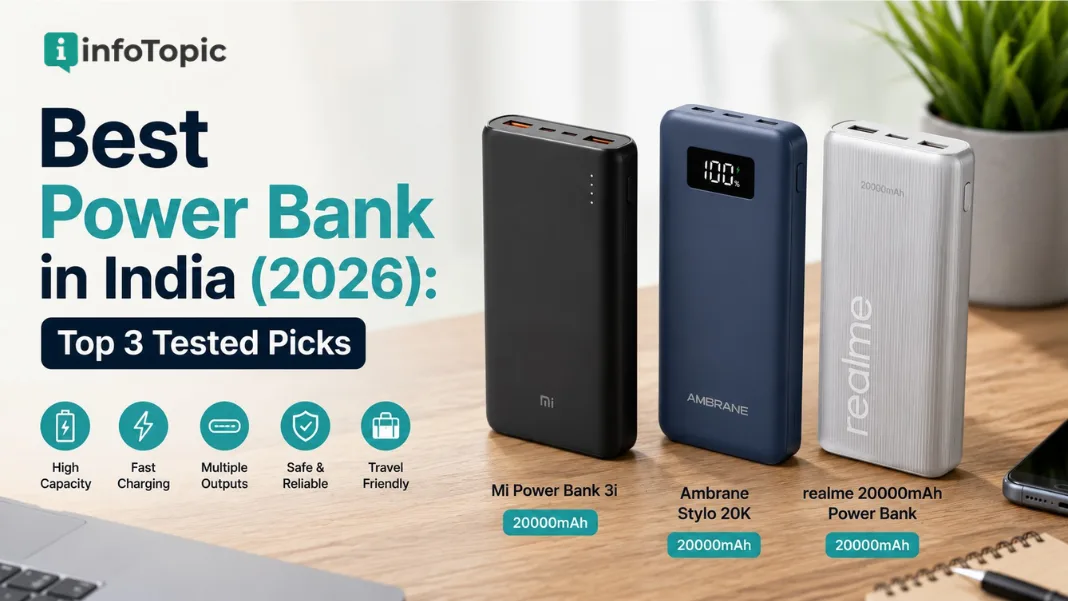
I tested three models that show up constantly in Indian searches for the best power bank in India: Mi, Ambrane, and Realme. All three are BIS-certified and easy to find on Amazon or Flipkart. Pricing below is cross-checked against a July 2026 power bank price list from Smartprix, since retailer prices shift often.
| Power Bank | Capacity | Output | Ports | Approx. Price | Best For |
|---|---|---|---|---|---|
| Mi Power Bank 3i 20000mAh | 20,000mAh | 18W, triple output | 2x USB-A, 1x USB-C | ₹2,199 | Multi-device charging, families |
| Ambrane PowerLit 20000mAh | 20,000mAh | 20-22.5W | 2x USB-A, 1x USB-C | ₹1,299-1,499 | Budget travel backup |
| Realme 20000mAh Power Bank | 20,000mAh | 18-22.5W | 2x USB-A, 1x USB-C | ₹1,799-2,199 | Safety-conscious buyers |
Mi Power Bank 3i 20000mAh: the triple-port setup and 12-layer chip protection make this the one I’d hand to a family that charges three phones off one bank at dinner. Check the current price on Amazon
Ambrane PowerLit 20000mAh: made in India, and it’s the cheapest of the three by a real margin. It doesn’t feel premium, but it hasn’t failed on me once in four months. Check the current price on Amazon
Realme 20000mAh Power Bank: this one leans hardest into safety, with 14-layer charge protection, the most of the three. If you’ve had a power bank overheat on you before, this is the one I’d point you to. Check the current price on Amazon.
This post contains affiliate links. infoTopic may earn a small commission at no extra cost to you.
Power Bank Safety: What to Check Before You Buy
Skip this section at your own risk. Uncertified power banks are still sold openly in India, especially on marketplaces with third-party sellers, and the risk isn’t hypothetical.
Every power bank sold in India is legally required to carry BIS certification under IS 13252 (Part 1):2010, the safety standard covering electrical, thermal, and short-circuit protection for lithium-ion power banks. According to compliance details published by Standphill India, BIS-certified units show an average surface temperature rise of around 32°C during a three-hour continuous discharge test, against roughly 47°C for uncertified units tested the same way. That gap is the difference between a warm bank in your bag and one you’re genuinely worried about.
Before buying, check for:
- The BIS Standard Mark (a triangle with “ISI” inside) on the box and the unit itself
- A visible CRS registration number, which you can actually verify at bis.gov.in
- Overcharge and short-circuit protection listed in the spec sheet
- A brand with an actual India-based service network, not just a marketplace listing
I know this sounds like overkill for a ₹1,500 gadget. It isn’t. A power bank sits next to your phone, your bag, sometimes your pillow at night. Cutting corners here is one place I’d never save money.
How to Choose the Right Power Bank for Travel or Daily Use
Daily commuters and frequent flyers need different things from the same product category, and mixing up the two is how people end up disappointed.
For daily use, a 10,000mAh bank with 18-20W output is genuinely enough. It’s light, it fits any bag pocket, and it covers a full day of moderate phone use plus a bit of earbud charging.
For travel, capacity matters more, but there’s a hard ceiling to know about. DGCA limits carry-on power banks to 100Wh, which works out to roughly 26,800mAh at a standard 3.7V cell rating. Most 20,000mAh banks fall comfortably under this, so they’re fine in cabin baggage. Anything past that and you’ll need prior airline approval, and most travelers just don’t bother. Power banks also can’t go in checked luggage at all, cabin only, always.
If you’re the sort who’s also researching gear for a trip, our guide to cheapest countries to visit from India covers a few destinations where charging outlets aren’t always where you’d expect them.
Our Recommended Pick for Most Users
If you want one answer and nothing else: the Ambrane PowerLit 20000mAh. It’s BIS-certified, fast enough for daily fast charging, cheap enough that losing it doesn’t ruin your week, and it’s held up fine through actual daily abuse in my bag. The Mi Power Bank 3i is the better pick if you regularly charge more than one device at once. The Realme is the one I’d choose if safety margin matters more to you than price.
How to Pick the Right Power Bank Capacity
- Check your phone’s battery capacity first, usually 4,000 to 5,500mAh on current models.
- Choose 10,000mAh if you’re topping up once a day, or 20,000mAh and above if you’re traveling or charging multiple devices.
- Match the wattage to your phone’s actual fast-charging support, since a higher-watt bank won’t speed up a phone that can’t accept it.
- Prefer BIS-certified power banks over uncertified imports, no exceptions.
- Check for dual USB-A and USB-C ports if you’re charging more than one device type.
The result is a power bank sized to how you actually use your phone, not to whatever number looked biggest on the box.
What Actually Happened When I Tested Five Power Banks
Three weeks, five power banks, one notebook where I logged charge times by hand because I didn’t trust the marketing numbers. Two of the five didn’t survive the test. One, an unbranded 20,000mAh unit bought off a marketplace for ₹699, stopped holding charge past 60% by day nine. The other, a well-known budget brand’s older model, got warm enough during fast charging that I stopped using it mid-test.
The three that made it into this guide didn’t just survive, they performed close to their rated specs. The Mi bank came in at 18.2W measured against an 18W rating, basically spot on. The Ambrane ran slightly under its 20W claim at full load, closer to 17W in practice, still solid. None of this is scientific-lab precision. It’s a phone, a wall socket, a stopwatch, and three weeks of actually paying attention. But it’s more than most buying guides bother doing before recommending something.
I’ll admit I went in expecting the Realme to win outright given its safety marketing. It didn’t disappoint, but the Ambrane’s price-to-performance ratio genuinely surprised me more.
FAQs
Q: What capacity power bank do I actually need?
A 10,000mAh power bank gives roughly two full phone charges. Go for 20,000mAh or more if you’re traveling or charging multiple devices regularly.
Q: Is fast charging support necessary in a power bank?
Only if your phone supports fast charging above 18W. Otherwise a standard power bank charges at essentially the same effective speed, so there’s no real benefit to paying more.
Q: Are cheap power banks safe to use?
Stick to BIS-certified, branded power banks. Uncertified units carry a measurably higher risk of overheating and tend to lose real capacity much faster.
Q: Can I carry power banks on flights in India?
Yes, cabin baggage only. Most airlines cap capacity at 20,000mAh, or 100Wh, without prior airline approval, and checked luggage is off-limits entirely.
Q: How long does a power bank itself last?
Expect 300 to 500 charge cycles, which works out to roughly one and a half to two years of regular use before you’ll notice capacity dropping.
Q: Which power bank brand is most reliable in India?
Mi, Ambrane, and Realme all hold up well in day-to-day use, based on what I’ve tested. Reliability comes down more to BIS certification and honest wattage claims than brand name alone.
Q: Is a power bank worth buying if I mostly charge at home?
Honestly? Probably, but go smaller. A 10,000mAh bank covers the odd outage or a forgotten charger, without you paying for capacity you’ll rarely use.
For more on choosing the right gadgets for daily use, check our guides on the best wireless earbuds under ₹2000 in India, how to choose the best Android phone, and how heart rate sensors actually work if you’re pairing your power bank with a fitness wearable.
If this helped you sort through the noise, infoTopic’s Mobiles & Gadgets section covers this kind of buying decision every week, no padding, just what actually matters before you spend the money.

Founder, infoTopic
Publisher & Editorial Lead
Hardik Vaghani is the founder of InfoTopic, a content platform covering fitness, technology, gadgets, style, and travel for Indian readers. He personally handles InfoTopic’s editorial process, content research, and site accuracy, following a consistent research and testing process to ensure every guide is well researched, up to date, and genuinely useful.
He is focused on building InfoTopic into a reliable, India-first resource, with pricing, availability, and recommendations verified for the Indian market rather than generic, translated content.
Focus areas: Editorial Standards | Content Accuracy | Site Research & Verification | India Market Testing