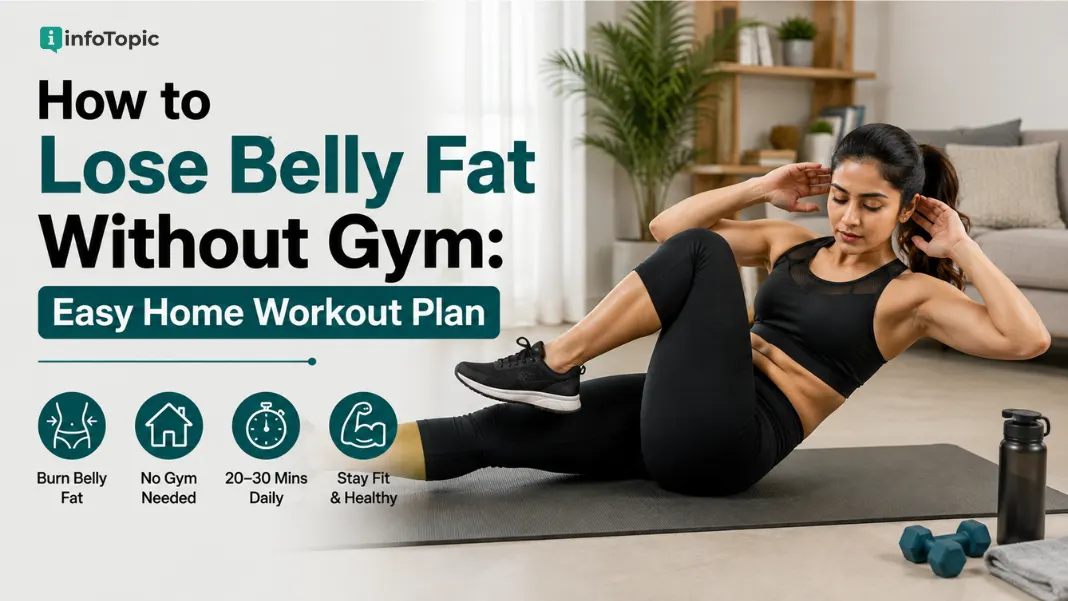
Three months into a gym membership I barely used, I cancelled it and did the whole thing from my living room floor instead. That’s the honest starting point for this guide. If you’ve been searching for how to lose belly fat without gym access, you’re not looking for motivation quotes. You want a routine that actually fits into a normal week, and one that doesn’t need a treadmill or a trainer standing over you.
At Infotopic, we get versions of this question constantly, especially in January and again every March when summer clothes start feeling tight. The good news: your living room, a bit of floor space, and 30 minutes a day are genuinely enough. The exercises aren’t fancy. The diet part matters more than most people want to admit. And the results take weeks, not days.
The Short Version
You can lose belly fat without gym equipment by combining daily bodyweight cardio (jumping jacks, skipping, brisk walking), 10 minutes of core work, and a modest calorie deficit through better food choices. Add 7-8 hours of sleep and consistent tracking, and most people see visible waist changes in 4-8 weeks.
Can You Really Lose Belly Fat Without Going to the Gym?
Yes, and this isn’t wishful thinking. Fat loss happens when you burn more energy than you take in, and your body pulls that energy from stored fat across your whole system, not from one muscle group at a time. A gym gives you machines and variety. It doesn’t give you a metabolic shortcut that a resistance band and your own bodyweight can’t replicate.
What actually moves the needle is consistency and intensity, not the postcode of where you sweat. So the real question isn’t “can I lose belly fat without a gym.” It’s whether you’ll show up on the floor five days a week for a month. That part is on you.
Understanding Spot Reduction Myths
Here’s a myth that refuses to die: doing 200 crunches a day will melt the fat sitting over your abs. It won’t. A 2022 meta-analysis covering more than 1,000 participants looked at whether localized muscle training could shrink fat in the surrounding area, and the pattern across that body of research was consistent. Ab work builds muscle underneath the fat. It doesn’t selectively burn the fat covering it.
I used to believe otherwise. Years of doing sit-ups every morning taught me the hard way that a strong core and a flat stomach are two separate projects. One comes from training. The other comes from diet and overall fat loss. Once I stopped treating crunches like a fat-burning tool and started treating them like a strength tool, the whole plan made a lot more sense.
Best Home Exercises to Lose Belly Fat
These are the exercises that actually deserve a spot in a home belly fat routine, ranked by how much bang you get for very little equipment.
| Exercise | Best For | Equipment | Difficulty | Calories (approx./15 min) |
|---|---|---|---|---|
| Skipping rope | Fast calorie burn | Rope (₹150-300) | Moderate | 180-220 |
| Jumping jacks | Warm-up cardio | None | Easy | 120-150 |
| Plank | Core stability | None | Moderate | 60-80 |
| Crunches | Ab strength | None | Easy | 50-70 |
| Bodyweight HIIT circuit | Fat loss + conditioning | None | Hard | 150-200 |
1. Cardio: Jumping Jacks and Skipping
Jumping jacks cost nothing and raise your heart rate within 30 seconds. Skipping rope does the same, only harder, and a decent rope costs less than a coffee at a café. Do 3 rounds of 1 minute jumping jacks with 30 seconds rest, then 3 rounds of 1 minute skipping. That’s under 10 minutes and it’s already a real cardio session.
Brisk walking counts too, and it’s the most underrated exercise on this list. A 30-minute walk at a pace where talking feels slightly effortful burns roughly 150-200 calories depending on your weight. Do it daily and that’s over 1,000 calories a week from walking alone.
2. Core Exercises: Plank and Crunches
Plank builds the deep stabilising muscles that flatten your posture, which honestly does more for how your stomach looks than crunches ever will. Start with 3 sets of 20-30 seconds. Add 10 seconds each week.
Crunches still deserve a place, just not as the centrepiece. Do 3 sets of 15-20, focusing on a slow, controlled squeeze rather than speed. If your lower back hurts during floor work, a padded surface helps a lot, and this is where a decent mat matters. We’ve reviewed a few solid, affordable options in our guide to the best yoga mat under ₹500 in India if your floor is hard tile.
3. High-Intensity Interval Training (HIIT) at Home
This is the section that changes results fastest. HIIT at home means alternating short bursts of near-maximum effort with brief recovery, and it’s backed by more research than almost any other home workout format. The American Council on Exercise notes that HIIT is linked to reduced abdominal and subcutaneous fat, along with improved insulin sensitivity, despite involving a relatively small total volume of exercise.
Fifteen minutes of proper HIIT, done at genuine effort, beats 45 minutes of half-hearted cardio. That’s not an exaggeration. It’s just how the intensity math works.
Sample 15-Minute HIIT Routine
- Warm-up: 2 minutes of jumping jacks
- 40 seconds high knees, then 20 seconds rest. Repeat 3 times
- 40 seconds mountain climbers, then 20 seconds rest. Repeat 3 times
- 40 seconds squat jumps, then 20 seconds rest. Repeat 2 times
- Cool down: 2 minutes of slow walking and stretching
The result is a full-body sweat in under 15 minutes, no equipment required. If you want to track effort more precisely, a fitness band with heart rate monitoring helps you confirm you’re actually hitting the intensity zones that matter. Our heart rate sensor guide explains how these sensors work and how accurate the budget ones really are.
Diet Tips to Reduce Belly Fat
Exercise gets the attention. Diet does most of the actual work. You can’t out-train a consistently poor diet, and belly fat is particularly stubborn to hormonal and dietary triggers like sugar and stress.
Foods to Eat More Of
Protein first, always. Eggs, dal, paneer, chicken, fish, and Greek yoghurt keep you fuller for longer and support muscle while you’re in a deficit. Fibre-rich vegetables, oats, and whole fruits slow digestion and blunt the blood sugar spikes that drive fat storage around the midsection.
Water-rich foods like cucumber, watermelon, and soups add volume without many calories, which matters more than people expect when you’re trying to eat less without feeling starved.
Foods to Avoid or Limit
Sugary drinks are the single easiest win here. Colas, packaged juices, and sweetened tea or coffee add hundreds of empty calories a day that don’t touch your hunger at all. Cut these first, before anything else.
Refined carbs, deep-fried snacks, and processed packaged foods are next. You don’t need to eliminate them completely. Most people do fine cutting them to once or twice a week instead of daily.
Importance of a Calorie Deficit
Here’s the part nobody likes to hear: no exercise routine outworks a calorie surplus. A mild deficit of 300-500 calories a day, sustained through portion control rather than crash dieting, is what actually shrinks belly fat over weeks. Extreme diets often backfire, slowing metabolism and triggering the exact cravings you’re trying to avoid.
Portion control beats calorie counting for most beginners. Smaller plates, protein-first meals, and cutting liquid calories will get you most of the way to a deficit for belly fat loss without ever opening a calorie-tracking app.
Daily Habits That Help Reduce Belly Fat Naturally
Exercise and diet cover maybe 70% of this. The remaining 30% comes down to habits most people underrate completely.
Sleep and Stress Management
Poor sleep raises cortisol, and elevated cortisol is directly tied to abdominal fat storage. A narrative review published in NIH’s PMC database found that sleep restriction increases hunger and appetite by altering metabolic and endocrine function, with evening cortisol and ghrelin levels rising while leptin drops, which is a fairly precise way of saying poor sleep makes you hungrier for the wrong foods the next day.
Seven to eight hours isn’t a luxury here. It’s part of the routine, as much as the plank or the skipping rope is.
Staying Hydrated
Two to three litres of water a day, more if you’re sweating through HIIT sessions. Dehydration is regularly mistaken for hunger, and a glass of water before meals genuinely reduces how much you eat without any willpower involved.
Step-by-Step: 4-Week Home Routine to Lose Belly Fat
- Start with 20-30 minutes of home cardio (jumping jacks, skipping, brisk walking) 5 days a week.
- Add 10 minutes of core exercises like planks and crunches after cardio.
- Maintain a mild calorie deficit through portion control rather than crash dieting.
- Cut down on sugary drinks and processed snacks.
- Sleep 7-8 hours and manage stress, since both directly affect belly fat storage.
- Track your waist measurement every 2 weeks instead of only relying on the weighing scale.
The result is a structured month that builds intensity gradually instead of burning you out in week one.
Week 1-2: Building the Habit
Focus purely on showing up. Cardio 5 days, core work 3 days, nothing heroic. This phase is about proving to yourself that a no-gym belly fat routine fits your actual schedule, not an idealised one.
Week 3-4: Increasing Intensity
Once the habit sticks, add the 15-minute HIIT circuit twice a week and extend plank holds. This is where most people start noticing their clothes fit differently, even before the scale moves much.
Tip: Track Waist Measurement, Not Just Weight
The scale lies constantly during this process, since muscle gain and water retention mask fat loss. A tape measure around your navel tells you far more. The World Health Organization flags a waist above 94cm for men and 80cm for women as a marker of elevated health risk, so it’s a genuinely useful number to track, not just a vanity metric.
What Actually Happened When I Tried This
Back in early 2025, I gave this exact structure eight weeks, tracking everything in a notes app because I didn’t trust myself to remember. Weeks one and two were rough. I skipped two HIIT sessions and ate a full bag of chips one Sunday and nearly gave up out of guilt. That’s normal, by the way.
By week four, walking 30 minutes plus 10 minutes of core had stopped feeling like a chore. My waist measurement dropped from 92cm to 87cm by week eight, without touching a single machine. Sleep was the habit I underestimated the most. The two weeks I slept badly were also the two weeks progress stalled completely, which tracks with everything the research says about cortisol and appetite.
FAQs
Q1. Can belly fat be reduced without any equipment?
Yes. Bodyweight cardio, core exercises, and a calorie-controlled diet can effectively reduce belly fat without any gym equipment at all.
Q2. How long does it take to see belly fat loss results?
Most people notice visible changes after 4-8 weeks of consistent exercise and diet control, though this varies with starting weight and how strict the deficit is.
Q3. Can I lose belly fat by diet alone without exercise?
Diet plays the biggest role in fat loss overall. Exercise speeds up results, improves muscle tone, and makes the loose-skin phase less noticeable, so combining both works better than diet alone.
Q4. Do ab exercises alone burn belly fat?
No. Ab exercises strengthen your core muscles, but they don’t specifically burn fat sitting over that area. Overall fat loss still requires a calorie deficit.
Q5. Is walking enough to lose belly fat?
Brisk daily walking, paired with a controlled diet, meaningfully contributes to belly fat loss over time, especially for beginners who aren’t ready for HIIT yet.
Q6. Is it better to do cardio or strength training at home for belly fat?
Both matter, honestly, and picking one over the other is missing the point. Cardio burns more calories per session, while bodyweight strength work like planks preserves muscle during a deficit, so the routine above uses both.
Q7. Why isn’t my belly fat going down even though I’m exercising daily?
Usually it’s diet, sleep, or both. A daily workout with unchecked snacking or 5-hour sleep can stall progress completely, no matter how consistent the exercise is.
Q8. What’s a realistic home workout budget for a beginner in India?
Under ₹500 total. A skipping rope costs around ₹150-300, and a basic yoga mat can be found under ₹500, which covers everything this entire routine needs.
About infoTopic: This guide was researched and written by the Infotopic team, who cover fitness, wellness, and lifestyle topics for Indian readers at infotopic.in. Our approach favours structured, testable routines over generic advice. See our full Fitness section for more home workout and wellness guides.
If a persistent stomach ache, unexplained weight change, or joint pain is holding back your routine, it’s worth reading our guide on managing joint pain with home remedies before pushing into HIIT. And if you want to track your progress properly, our picks for the best smartwatch under ₹2000 in India cover budget options with decent step and heart-rate tracking.
Start this week: pick one cardio session and 10 minutes of core work today. Everything else in this guide builds from that first day.

Founder, infoTopic
Publisher & Editorial Lead
Hardik Vaghani is the founder of InfoTopic, a content platform covering fitness, technology, gadgets, style, and travel for Indian readers. He personally handles InfoTopic’s editorial process, content research, and site accuracy, following a consistent research and testing process to ensure every guide is well researched, up to date, and genuinely useful.
He is focused on building InfoTopic into a reliable, India-first resource, with pricing, availability, and recommendations verified for the Indian market rather than generic, translated content.
Focus areas: Editorial Standards | Content Accuracy | Site Research & Verification | India Market Testing